
.png)
Have you ever thought about changing how your company handles employee insurance coverage? Benefits like healthcare are some of the largest costs faced by businesses today and they’re only growing, with family premiums rising by 52% over the last decade alone.1But if you have a fully insured plan, you probably don’t have a lot of insight into what’s driving those numbers or how to start bringing them down.
Fortunately, there’s another option out there, one with big potential benefits in terms of flexibility, insight, and savings: self-funding your plan.
So, what’s the difference between the two?
They differ according to who assumes the insurance risk, who determines the plan characteristics, who makes the payments and who is ultimately responsible for compliance governance:
- Fully-insured plan:Employer purchases insurance from an insurance company. The insurance company is then responsible for assuming risk and running the plan.
- Self-funded plan: Employer provides health benefits directly to employees, assuming the financial risk and taking on the responsibility of running the plan.
To help you better understand the differences between self-funded and fully insured, we’ll walk through both healthcare insurance models, looking at how they work, discussing pros and cons, and diving into the details you need to know if you’re thinking about making the switch.
Fully Insured Plans
Fully insured health plans are the traditional model, and the simplest to implement.
Your business pays a fixed premium to an insurance carrier (usually one of the “big four”: BlueCross BlueShield, UnitedHealthcare, Cigna, or Aetna), and in return, the carrier assumes all the financial risk of providing health coverage for insured events. They handle claims and administration, while you focus on paying the premiums, which are based on the number and demographics of the people you’re insuring.

.svg)
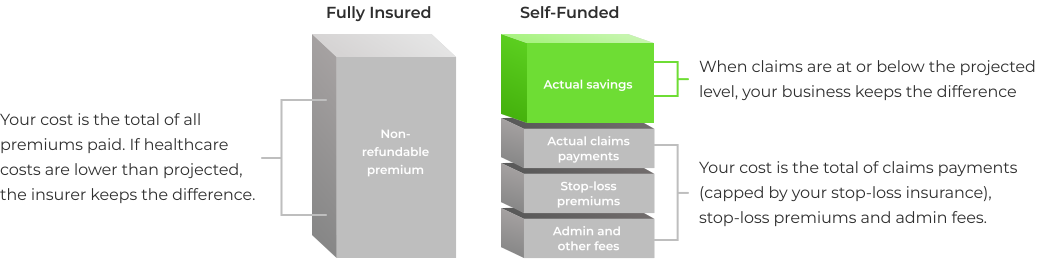
In a fully-insured model, insurers raise rates when their costs go up, but if your group’s claims are lower than expected, the carrier keeps the difference as profit—not you. For some companies, that’s an acceptable tradeoff. But for employers looking to control costs, tailor benefits, and create a better employee experience, there’s a better option.
Self-Funded Plans
In a self-funded model, your business takes direct ownership of its healthcare plan. You fund the claims and choose the partners you trust to administer, manage, and support the plan. This gives you greater control, transparency, and financial opportunity.
| Fully Insured | VS. | Self-Funded |
|---|---|---|
| The insurance company assumes the financial risk. | FINANCIAL RISK | Financial risk is assumed by the employer. |
| Plan design options are dictated by the insurer. | PLAN DESIGN | Employer has freedom to design plans how they like. |
| Monthly premiums paid to the insurer. | PAYMENTS | Fixed costs (admin fees and medical stop-loss premiums) plus variable costs (employee healthcare claims). |
| Plans must comply with state law. | COMPLIANCE | Plans are governed by the Employee Retirement Income Security Act of 1974 (ERISA), preempting state regulations. |
Now that we’ve talked about the top-level differences between self-funded and fully insured plans, it’s a time to get into the details around how self-funding works.

With a self-funded plan, your business is the sponsor. That means you’re ultimately responsible for setting up, administering, and paying for your employees’ healthcare plans. While self-funding has the potential to come with some financial risk, it also opens the door to significant savings, and puts you in charge of customizing a plan that truly fits your employee’s needs. Because you’re able to work with any partner, you’re empowered to choose precisely the care and support that works best for your employees. And because you’re ultimately the one funding it, the savings you get from building a more efficient plan can go right back to your bottom line.

One big advantage of self-funding is the flexibility it gives employers to build healthcare plans that work for their businesses and their employees. Compared to fully insured plans, which tend to be one-size-fits-all, self-funded plans can be tweaked and finessed, giving the employer more control over the benefits they offer. For example, a large employer might offer several different health plans to different kinds of employees, with benefits tailored towards specific occupations or even number of hours worked.

So, who helps you take care of all the details? Most self-funded employers choose to partner with a Third Party Administrator (TPA) to handle day-to-day plan operations like eligibility management, claims processing, customer service, compliance, and more.
While some employers use the administrative services of a large carrier-owned TPA under an ASO (Administrative Service Only) or “bundled” model, that kind of setup typically comes with carrier-driven limitations. Employers seeking full flexibility “unbundle” their plan, partnering with an independent TPA that isn’t owned by an insurance carrier.
An independent TPA gives you true control over all plan components: networks, pharmacy programs, medical management solutions, and more. They also help you analyze data and design the right plan structure to meet the unique needs of your employee population.

One of the big upsides to unbundled self-funding is the flexibility you can get when it comes to network access. Since you aren’t locked into a single network like you are in a fully insured or bundled plan, you’re able to pick and choose the networks that make the most sense for you and your employees. That might still mean going with one of the big providers, but it could also mean partnering with a regional network that can provide local care at more competitive rates. Working with an independent TPA also gives you the flexibility to deal with unique member needs, building in alternate arrangements for employees that have high medical costs so they can keep getting great care without your expenses ballooning.

When it comes to healthcare, doctor visits and hospital stays are only half the equation—you also need to figure out how you’ll manage pharmacy costs like prescription drugs. Pharmacy benefit managers, or PBMs, are a component of any plan, and big insurance companies have their own, in-house PBMs that they use with fully insured and bundled plans. Self-funding companies that work with an independent TPA, on the other hand, can choose whichever PBM best supports their needs. Experienced third-party PBMs can negotiate with pharmacies based on the needs and consumption patterns of your workforce in order to get the best deal for your members at the lowest cost to you.

In a self-funded plan, the employer acts as its own insurer. That means whn an employee has healthcare costs, your company pays them. Of course, real-world self-funded plans are more complicated than that—if a company tried to pay for all employee healthcare directly using its cash flow, one or two catastrophic claims could wipe them out! In fact, just 2% of members account for 47% of costs2, and that uncertainty is one of the hallmarks of healthcare spending. When you self-fund, you need to find a way to manage that unpredictability, limiting your financial risk even while you remain dedicated to giving employees the best care.

The most important risk-management tool a self-funded employer has is called is called medical stop-loss insurance. With a medical stop-loss insurance contract, you set a limit to the amount of money your company will pay out in claims over a set period. If your claims exceed that limit, the stop-loss insurer will cover the difference. In exchange, you pay regular premiums based on the risk the stop-loss insurer is taking on. Stop-loss insurance makes your costs predictable and protects you from catastrophic claims.
Medical stop-loss insurance provides financial predictability while allowing you to benefit from better-than-expected performance.

So how do your members navigate all the ins and outs of their care? That’s where medical management comes in. While fully insured or bundled plans are stuck with the cold, impersonal support offered by the big carriers, self-funding companies can work with their TPA to choose a medical management partner that makes it easier for members to understand and access their care.
At Allied, we’ve taken that one step further through Allied Care Solutions—our innovative approach to medical and cost management that’s fully integrated into our administration model. This built-in support means members receive more proactive, personalized guidance from the start, while employers gain powerful tools to manage complex cases and control costs.
Empathetic support leads to healthier, more satisfied employees, and Allied Care Solutions is designed to support long-term well-being by combining data-driven insight with clinical expertise to help members take ownership of their health. Because we oversee both claims and care, we’re able to close gaps, connect insights, and deliver better outcomes without added complexity.

After choosing a TPA and working with them to build a complete plan, you still have one more important task: putting together a summary plan description, or SPD. The SPD outlines every aspect of your care and coverage provisions. While creating this document and making sure it checks all the legal and compliance boxes can be complicated, you don’t have to worry if you’ve been working with a good TPA. Just as they’ve helped you figure out how your plan works and choose the partners that will help it run, your TPA can take charge of SPD creation, using their expertise to make sure every facet of your plan is clearly explained.
The Business Advantage of Self-Funded Plans
We’ve gone through some of the terms and concepts you need to understand how self-funding works, but so far we’ve only touched briefly on the big advantages unbundled self-funding can give your business: insight, flexibility, savings, and healthier, happier employees.

Big insurers can be a little like black boxes when it comes to your employees’ healthcare information. While they are happy to share some data, it can be hard to get really granular insight into how people are using their benefits. When you bring everything in-house, however, you have access to every data point, giving you new opportunities to tweak coverage and find efficiencies, giving employees better care while finding cost savings for your organization.

With unbundled self-funded plans, you’re not beholden to any insurance provider or third-party partner—you’re free to contract with whomever you please to build a healthcare plan that provides the best coverage at the best price. That gives you a level of flexibility that fully insured businesses can’t match, letting you build a benefits package that’s tailored to your employees’ needs at the price that works for your financial goals.

One of the biggest benefits of self-funding is the potential savings to you, the employer. That’s because, by taking on the risk, you also stand to benefit when things go well. If a fully insured plan runs better than expected, costing less in payouts, those savings are kept by the insurer as profit. On the other hand, in a self-funded plan, lower spend is directly translated into savings for the company, potentially leading to significantly reduced costs over time.

Finally, the very best reason to self-fund is that it’s the best option for the members who work for you. The flexibility that comes with self-funding your plan means you have the power to build a truly member-centric experience, one that gets your employees the very best care in a way that’s easy and stress-free for them. That way, your members are empowered to take control of their care, using the tools you’ve provided to build happier, healthier lives

The Allied Difference
As the nation’s largest independent third-party administrator, Allied offers employers unparalleled flexibility in running their self-funded plans, with the potential for big savings and superior care when compared to fully insured plans. Our fully integrated, member-centric service model gives you access to administrative services, member care solutions, and powerful analytics. And with access to 40+ PPO networks and integrations with 30+ stop-loss carriers, 45+ PBMs, and 200+ point solutions, you’ll have all the tools you need to build the best benefit plan for your people and your business.
References
1Kaiser Family Foundation, Premiums and Worker Contributions Among Workers Covered by Employer-Sponsored Coverage, 199-2024.
2Merlinos & Associates, Allied Advocate Actuarial Analysis